Learning the skill
In a controlled study of 50 healthy adults, the alpha rhythm rose over 12 training sessions.
How strong: One controlled study; not everyone learns
Hsueh et al., Human Brain Mapping 2016Guide for longevity centers
If you run a longevity center, your clients will ask whether brain training works. This guide gives you the answer in plain words: what published studies report, how strong that evidence is, and how to talk about it with clients.
The short answer
Published studies of brain training with live brain feedback (a method called neurofeedback) report that healthy adults can learn to raise targeted brain rhythms in about 10 to 12 sessions, and that programs of 8 to 20 sessions are associated with improvements in working memory and attention-related measures. The trials are mostly small, and the research is still developing. That is why a good program measures each client before and after.
The method
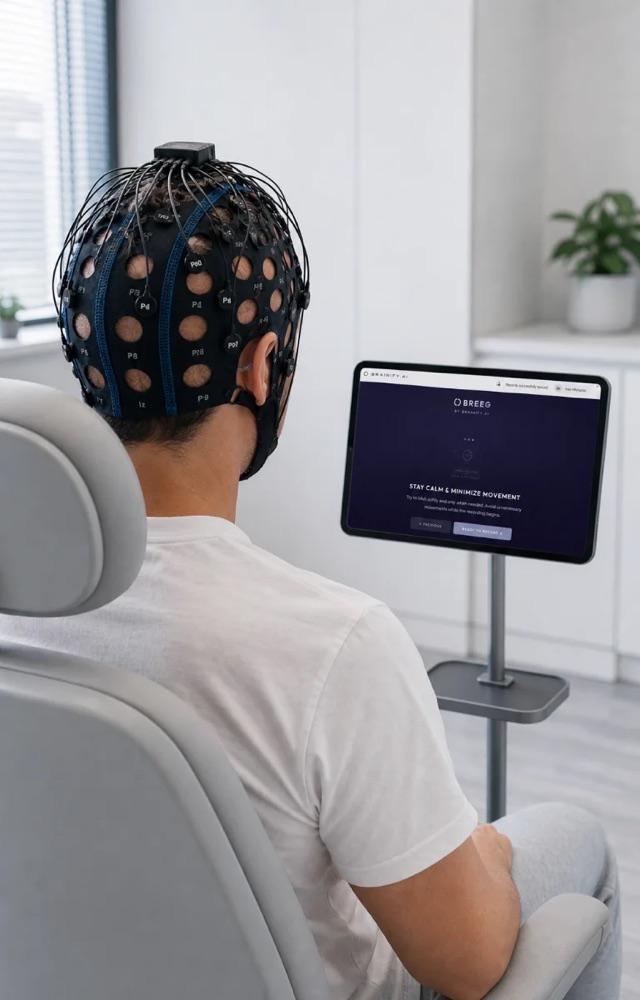
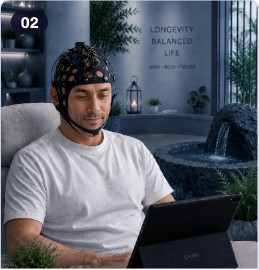
It is brain training with a live brain signal. A cap records the brain's electrical activity (EEG), and a game or animation responds in real time when the brain produces a target pattern. Over repeated sessions, people practise producing that pattern more often.
Brainify.AI programs train three patterns, one for each trainable score in the report:
Focus & Attention
Theta/beta balance
The balance between a slower rhythm (theta) and a faster one (beta), linked to steady, sustained attention.
Stress Resilience
SMR + heart rhythm
The sensorimotor rhythm (SMR), trained together with heart rhythm, linked to staying calm and recovering after a surprise.
Cognitive Clarity
Alpha up-training
Raising the alpha rhythm, linked to relaxed wakefulness and a calm, clear mind.
Our Brainify.AI model sets each session from the client's own baseline.
Sessions are non-invasive: the cap only records activity and sends nothing into the body.
The evidence
The strongest published signals in healthy adults are for working memory and for learning to raise a trained rhythm; focus results are earlier-stage. None of these studies tested a specific commercial product, including ours.
In a controlled study of 50 healthy adults, the alpha rhythm rose over 12 training sessions.
How strong: One controlled study; not everyone learns
Hsueh et al., Human Brain Mapping 2016A meta-analysis of 16 randomized studies (427 healthy adults) found alpha training associated with moderate working-memory improvements.
How strong: Meta-analysis of small trials
Yeh et al., Frontiers in Human Neuroscience 2020A double-blind, placebo-controlled study of 50 healthy adults reported stronger attention-related brain responses after 10 SMR sessions.
How strong: One well-designed trial; it measured a brain marker, not task performance
Dousset et al., NeuroImage 2025A meta-analysis of 14 trials (284 participants) reported moderate memory improvements, mainly in programs over 300 minutes of total training.
How strong: Meta-analysis of small trials
Lin et al., Medicina 2024A review of controlled studies in healthy participants describes reported gains in sustained attention, memory and mood.
How strong: Narrative review
Gruzelier, Neuroscience & Biobehavioral Reviews 2014Program length
8–20
sessions in published programs
In older adults, benefits appeared mainly above 300 minutes of total training. A 15-session program of about 25 minutes totals 375 minutes.
The field is growing, and most trials are small, typically 10 to 30 people per group, so results vary between studies.
For your center
Assess each client before the program and reassess after it, so they see their own numbers. Scores vary from day to day, so look at the trend.
Brain training is a wellness service for healthy adults. It is not a treatment for any condition.
Programs of 15 to 20 sessions sit inside the range the research used.
See a brain training session with your own team: we bring the kit for a demo day.
Request a demo dayThe science behind Brainify.AI
500,000+
brain scans in our reference dataset
150,000+
people in the pretraining of our Foundational Brain Model
30,000+
brain signal parameters analysed
An AI model pretrained on brain recordings from more than 150,000 people. It is behind the brain age estimate in every Brainify.AI report, and each client is compared with age- and sex-adjusted reference data from 500,000+ brain scans.
About the modelResearch collaborations with Harvard Medical School, Weill Cornell Medicine and UC Irvine.
Selected for Harvard Innovation Labs, J&J Innovation JLABS and Merck Digital Sciences Studio.
FAQ
It is non-invasive: the cap records brain activity and sends nothing into the body. Some people feel tired after a session.
Research programs typically ran 8 to 20 sessions. Brainify.AI programs are typically 15 to 20 sessions of about 25 minutes.
No. Results vary from person to person, and not everyone learns to change the trained rhythm. Reassessment shows each client where they stand.
No. For a longevity center it is a wellness service for healthy adults, not a treatment for any condition.
Demo day
We bring the kit for a day, train your team and assess your clients for free.
Prefer to talk first? Book a 30-minute call
Guides for longevity centers
Space, kit, staff, the client visit, and what to ask a provider.
ReadHow brain age sits next to biological age.
ReadAssessment, plans, brain training and the client app in one system.
Read