Brain age: what it is and how longevity centers use it
Your clients already know their biological age from blood or epigenetic tests. Brain age adds the organ they care about most and usually cannot measure: easy to understand, easy to compare between visits, and on the same page as the rest of their longevity profile.
Brain age is an estimate of how old a person’s brain activity looks compared with people of different ages. Brainify.AI calculates it from a short EEG recording with its Foundational Brain Model, pretrained on recordings from more than 150,000 people, and compares it with reference data from 500,000+ brain scans. A brain age of 36 for a 39-year-old means their brain patterns look typical of 36-year-olds. In a longevity center it is a wellness indicator to track over time, alongside biological age from blood tests, not a diagnosis.
The method
How brain age is estimated
Brain activity changes in predictable ways as people get older. Our Foundational Brain Model, an AI model pretrained on brain recordings from more than 150,000 people, learned those patterns, so it can estimate the age a new recording looks most like.
The recording
A light cap records the brain’s electrical activity (EEG) while the client sits and relaxes for about 6 minutes. No scan, no injection, no gel.
The comparison
Our Foundational Brain Model estimates brain age, and the result is compared with age- and sex-adjusted reference data from 500,000+ brain scans.
The result
One number in years, shown next to the client’s real age: younger, on track, or older than expected.
Sample report · illustrative
Real age
39
Brain age
36
YoungerOn trackOlder
A wellness indicator, not a diagnosis. Track it as a trend.
The evidence
Our published brain age research
Brainify.AI research · Frontiers in Aging Neuroscience, 2022
Predicting age from resting-state scalp EEG signals with deep convolutional neural networks
Our science team built a deep-learning model that estimates age from a resting-state EEG recording, developed on recordings from 1,274 people. It improved on the best published results for EEG age prediction at the time by 13%.
Lead author: Mariam Khayretdinova, Brainify.AI co-founder and CEO.
Centers use brain age as the headline number that opens the brain part of the longevity conversation.
01
At intake, next to biological age
Clients see brain age alongside the biological age from their blood or epigenetic tests, so the brain sits in the same profile as the rest of the body.
02
As one overall score
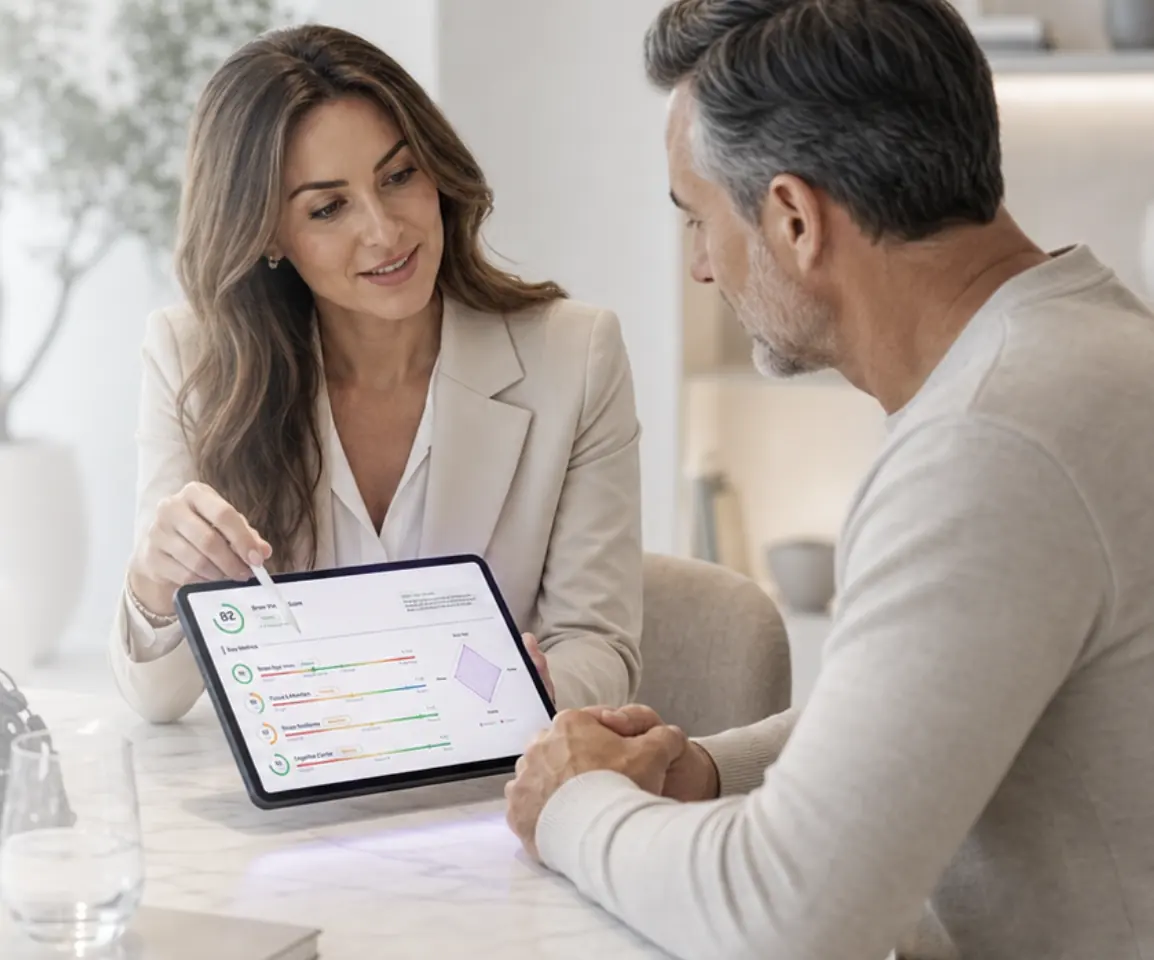
Brain age is shown as one overall number, next to a Brain Vitality Score and three metrics: focus and attention, stress resilience and cognitive clarity. If brain age is far from real age, that is a reason to look into it further.
03
As a long-term trend
From the second assessment, a trend chart shows brain age and the other scores over time. Brain age moves slowly, so its line is read over months, not weeks.
04
As a start for the plan
The personalized wellness plan suggests at-home routines and services from the center’s own menu. Your team chooses what to offer.
How to explain it to clients
Call it an overall score
Brain age describes how brain patterns compare with a reference group. It is not a diagnosis. A large gap from real age is a reason to look further, not a conclusion.
Show it next to real age
The number means most next to the client’s real age and their biological age from other tests.
Set the pace
Brain age changes very slowly, not overnight and usually not within a quarter. Compare it across months, not between two close visits.
See a brain age report on your own team: we bring the kit for a demo day.
Built on large-scale brain data and published research
500,000+
brain scans in our reference dataset
150,000+
people in the pretraining of our Foundational Brain Model
30,000+
brain signal parameters analysed
Our Foundational Brain Model
An AI model pretrained on brain recordings from more than 150,000 people. It is behind the brain age estimate in every Brainify.AI report, and each client is compared with age- and sex-adjusted reference data from 500,000+ brain scans.
Research collaborations with Harvard Medical School, Weill Cornell Medicine and UC Irvine.
Selected for Harvard Innovation Labs, J&J Innovation JLABS and Merck Digital Sciences Studio.
FAQ
Questions centers ask
How is brain age different from biological age?
Biological age usually comes from blood or epigenetic markers. Brain age comes from a recording of brain activity. They measure different things, which is why centers show both.
How long does the test take?
About 10 minutes in total, with 6 minutes of recording. The client sits and relaxes.
Can brain age change?
Yes, but very slowly. It does not change overnight, and most likely not within a quarter. Repeat assessments over time show the direction.
What if brain age is far from real age?
Brain age is shown as one overall score. If the gap from the client’s real age is large, that is a reason to look into it further.
Is it a medical test?
No. It is a wellness indicator, not a diagnosis.
Demo day
See it in your own center
We bring the kit for a day, train your team and assess your clients for free.
Your team runs real assessments with us in the room