Pharma & biotech R&D
Make the next decision on your CNS asset with greater confidence.
Brainify.AI combines population-scale CNS data, foundational brain models, and simplified EEG / ERP data collection to support clinical decisions from Phase I through Phase III.
Discuss your CNS asset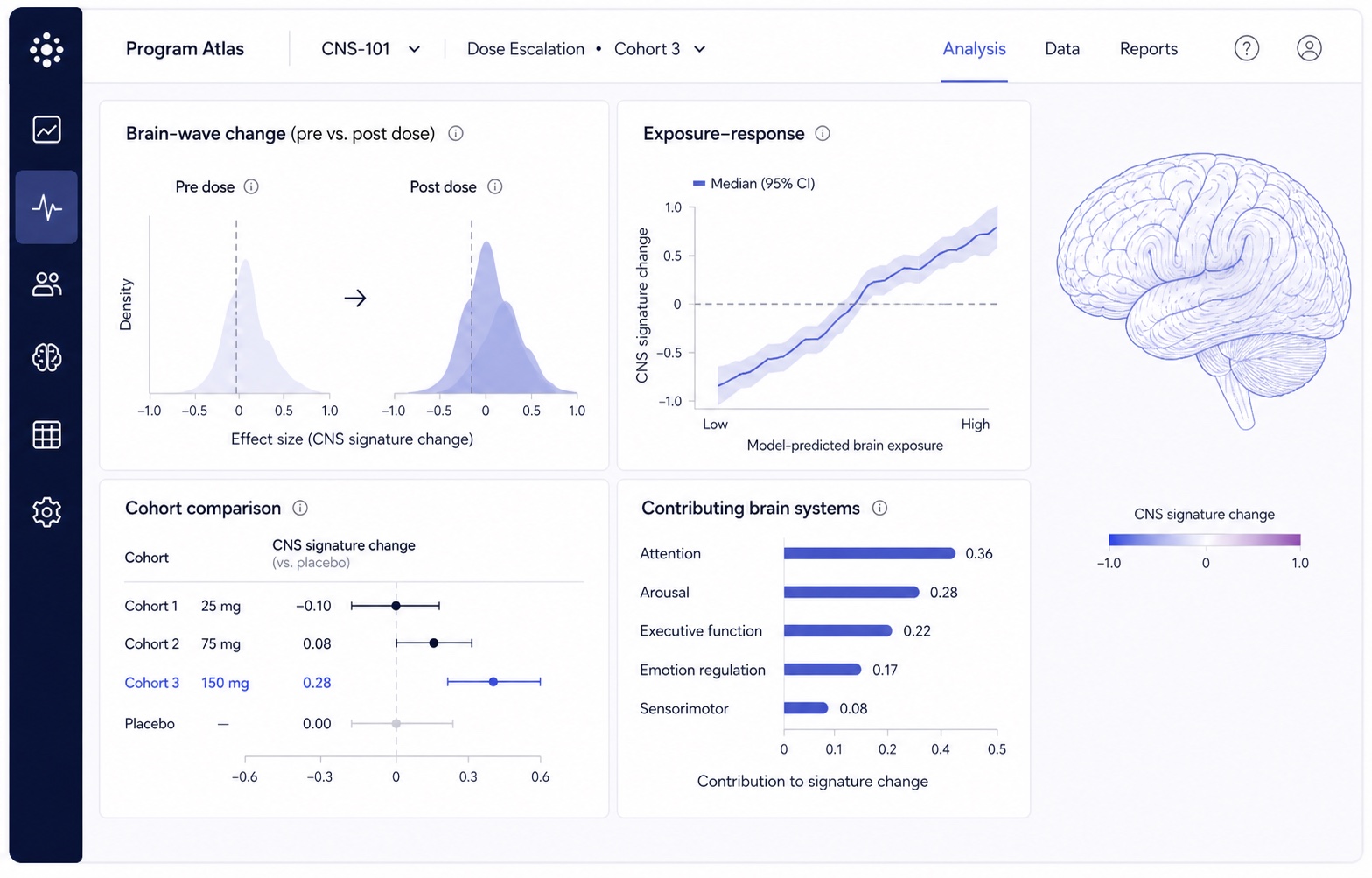
Illustrative product interface. Analysis is configured to the program and study.
Phase I
Does the drug produce a measurable effect in the brain?
Measure central pharmacodynamic changes in brain activity and, when PK data are available, explore exposure–response relationships.
Phase II
Who is most likely to respond?
Use population reference data and pretrained brain models to investigate responder profiles, placebo risk, and cohort strategy.
Phase III
How do we validate and scale the signal?
Prospectively validate the signal and standardize brain-wave collection, quality control, and analysis across the study.
Evidence
What Brainify.AI found in completed trial data.
We used the Foundational Brain Model to identify clinically relevant subgroups in completed Phase II and Phase III studies. The retrospective analyses made responder and placebo effects easier to see; prospective validation is still required.
Explore evidence and limitationsCAN-BIND-1 · N=181
Responder identification
Completed Phase IIb MDD study
The model-positive subgroup had a 58.6% observed response rate, compared with 47.5% in the full dataset.
+11.1percentage points
observed response-rate difference
Retrospective re-analysis of a completed escitalopram study; not a prospective result.
View study summaryEMBARC · N=199
Placebo-risk stratification
Completed Phase III depression study
Stratifying participants by predicted placebo-response risk revealed a clearer sertraline-versus-placebo difference in the lower-risk subset.
p=0.01
after retrospective stratification, versus p=0.14 in the full dataset
Retrospective re-analysis of a completed sertraline-versus-placebo study; not a prospective result.
View study summaryPlatform
One measurement platform. Three connected capabilities.
An open system that turns brain-wave data into signals your team can use across development.
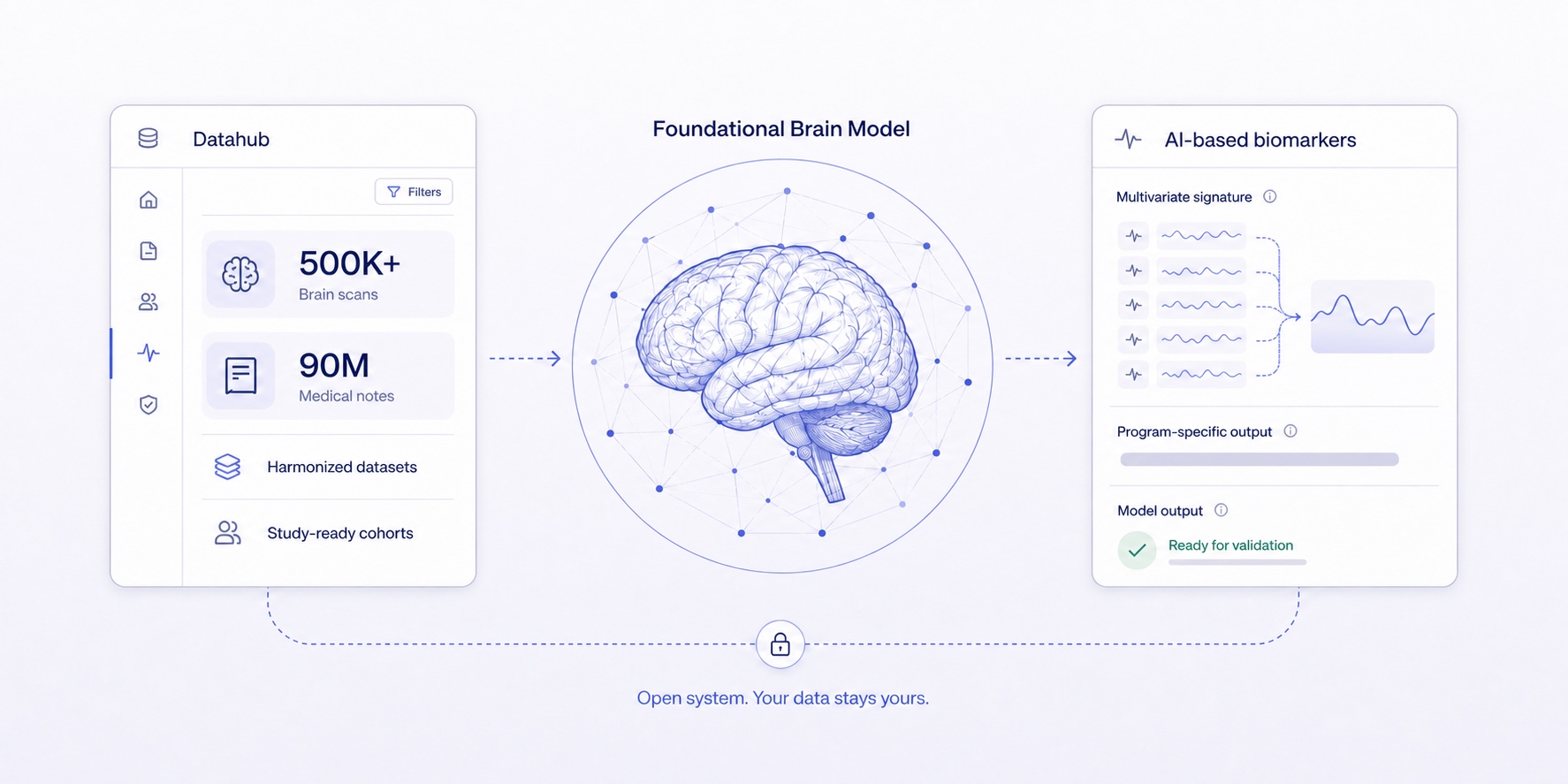
Datahub
Curated, harmonized brain-wave datasets for feasibility, population comparators, and cohort design.
- Study and site agnostic
- Quality and metadata standardized
- Privacy by design
Foundational Brain Model
A pretrained brain representation that can be adapted to responder, placebo, and biomarker questions.
- Cross-study learning
- Biologically grounded signals
- Continuously improving
Brain Measurement Kit
Guided EEG / ERP collection that is easy to deploy across sites and distributed clinical trials.
- Simplified data collection
- Distributed-trial ready
- Standardized quality control
A Phase I example
Your study is small. Its reference population doesn’t have to be.
In a recent Phase I generalized anxiety disorder (GAD) program, Brainify.AI built reference distributions from 859 people with a GAD diagnosis and more than 100,000 clinically referred comparator records. The purpose was simple: establish the baseline, then test whether the asset produces a measurable shift in brain activity.
01
Establish the reference
Build indication-specific and broader comparator distributions from population-scale brain-wave data.
02
Measure the change
Compare pre-dose and post-dose brain activity using pre-specified features and quality-controlled recordings.
03
Connect exposure and response
When PK data are available, investigate whether brain response changes with drug exposure or dose.
Evidence of a central pharmacodynamic effect—not an automatic claim of efficacy or confirmed molecular target engagement.
Selected CNS programs
See how the platform has been used.
Different assets create different development questions. These examples show how Brainify.AI has supported early pharmacodynamic interpretation, responder strategy, and indication exploration.
Phase I · Generalized anxiety disorder (GAD)
Is the observed brain change larger than natural variation?
Population reference distributions helped a pharmaceutical team interpret brain-wave changes from an approximately 30-subject study.
Datahub · Population reference analysis
Read the case studyPhase II · PTSD program
Can a pretrained brain model help identify likely responders?
Honeybrains Biotech used the Foundational Brain Model to support responder-biomarker work for a Phase II clinical program.
Foundational Brain Model · Responder strategy
Read the case studyApplied research · CNS asset
Where else could an asset have therapeutic relevance?
Negev Labs used Datahub to map new therapeutic opportunities for a promising CNS compound in under four weeks.
Datahub · Opportunity mapping
Read the case studyEngage
Start with your CNS asset.
Tell us about your program and we’ll recommend a sensible first validation step.
Your selections are used only to prepare the contact conversation; do not include confidential study data here.
Regulatory context
Brainify.AI biomarkers are currently investigational and have not been qualified by FDA or EMA. Deliverables can support exploratory endpoints, analysis plans, and regulatory discussions.
Data governance
De-identified data, access controls, audit trails, and sponsor-ready documentation. Detailed data rights and security materials are available for qualified programs.
Bring us the next decision on your CNS asset.
We’ll begin with your indication, phase, and development question—then show the relevant Brainify.AI capabilities and a sensible first validation step.
Discuss your CNS asset