How to add a brain assessment to your longevity center
Most longevity menus already measure the body: bloodwork, VO2 max, body composition, biological age. The brain is usually covered by a questionnaire, if at all. This guide walks through what you need, how it fits into the client visit, and what to ask a provider before you sign.
10 minutes, non-invasive, no gel. A wellness service, not a medical test.
Onboarding in as little as one week
10-minute assessment in the same visit
Your team trained on site in one day
The short answer
How do I add a brain assessment to my longevity center?
Set aside a quiet room of about 6 m², train your team (under an hour per person), and add a 10-minute non-invasive brain assessment to your client visit. Use the report to talk through next steps from your own menu, offer a brain training program to clients who want to work on their scores, and reassess regularly so clients can compare their numbers. Position it as a wellness service, not a medical test.
Steps 1–4 · Set up
From signed contract to first client
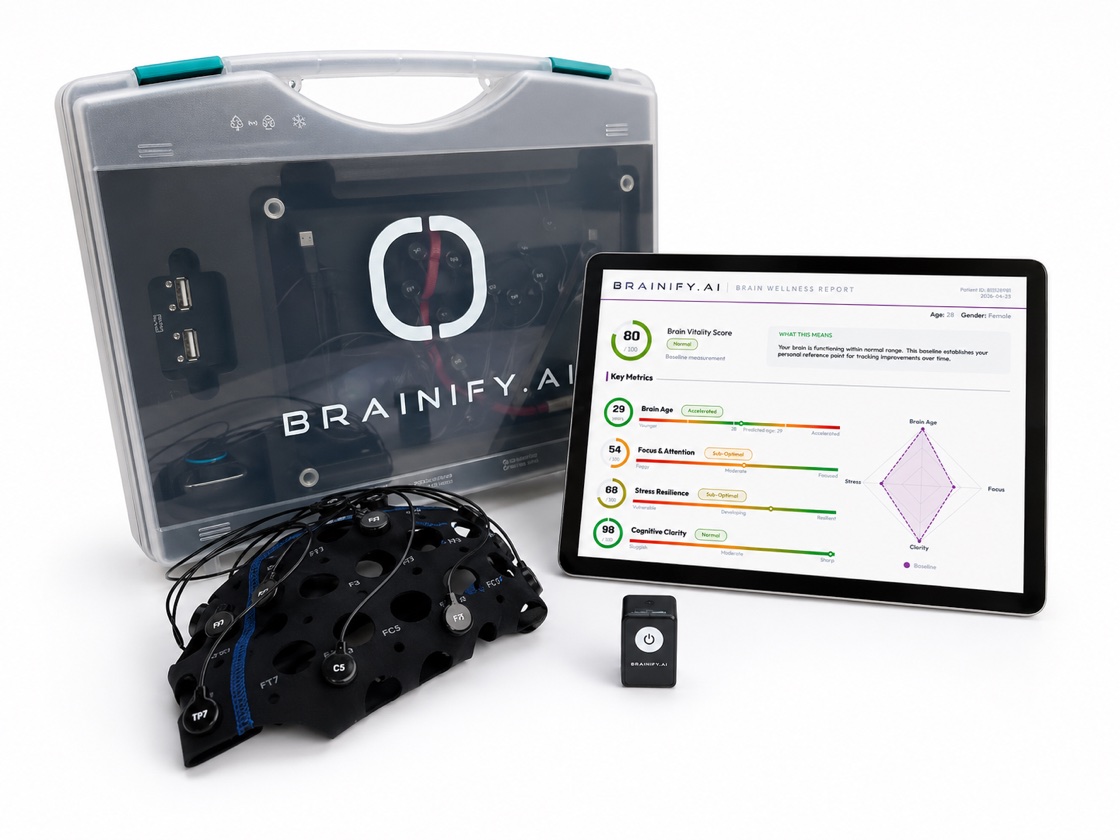
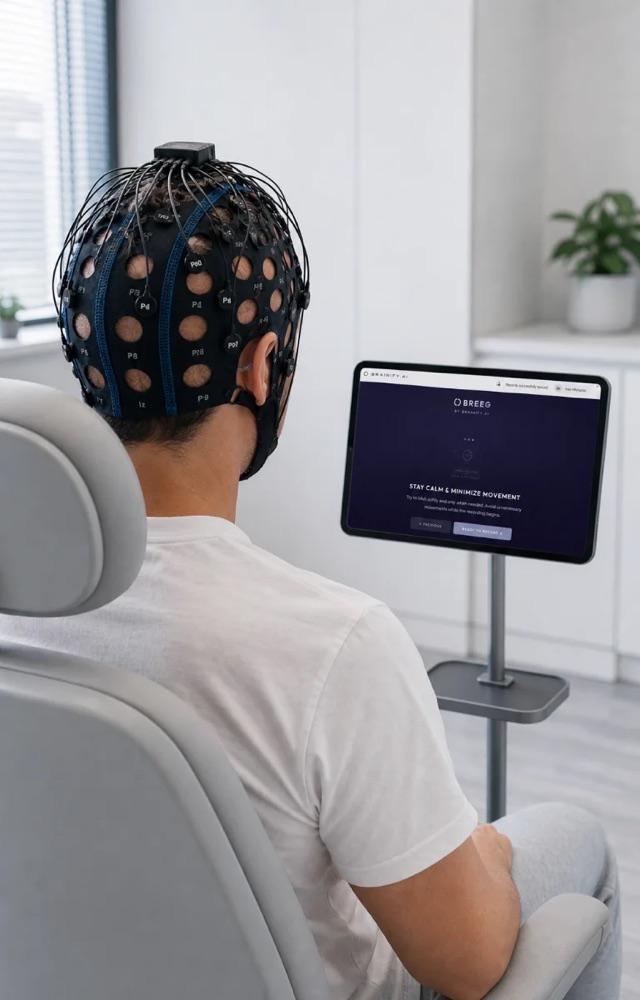
The kit: 2 dry caps (M and L), amplifier, tablet, case
01
Sign and schedule onboarding
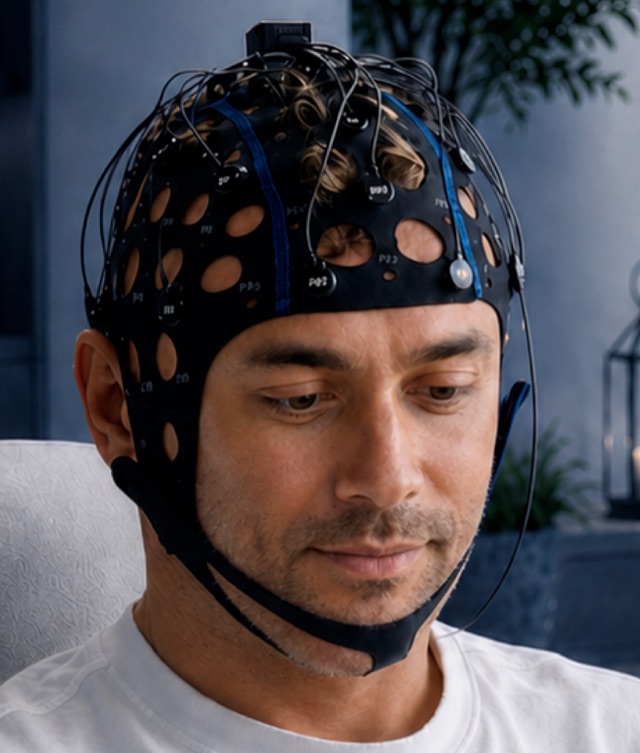
With Brainify.AI, onboarding can be as fast as one week from a signed and paid contract. The kit arrives in one carrying case: two dry brain-sensing caps (medium and large) that record EEG (the brain’s electrical activity), an amplifier and a tablet.
02
Prepare the space
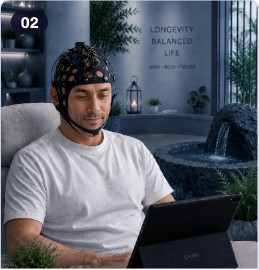
A quiet room of about 6 m² with a comfortable chair is enough. Dry caps need no gel, so no sink or hair wash. One kit serves one client at a time; two kits let you run an assessment and a training session in parallel.
03
Train your team on site
Our team comes to your center for a one-day training for everyone who will run it. Each person learns the assessment in under an hour. We suggest inviting clients that day, so staff run real assessments with us in the room to answer questions.
04
Choose who runs it
In most centers a nurse or a longevity expert runs the assessments. You do not need a clinician or a neuroscientist.
Steps 5–8 · With clients
Assess, review, train, reassess
05
Add it to the client’s visit
Run it in the same visit as your other baseline tests, on the first visit or a routine one. It takes about 10 minutes, with 6 minutes of recording; the client sits and relaxes. Ask clients to skip coffee and alcohol beforehand and, ideally, to come with clean hair.
06
Review the report with the client
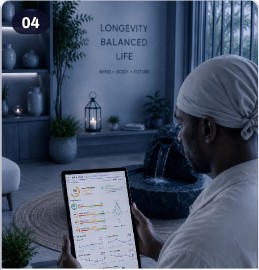
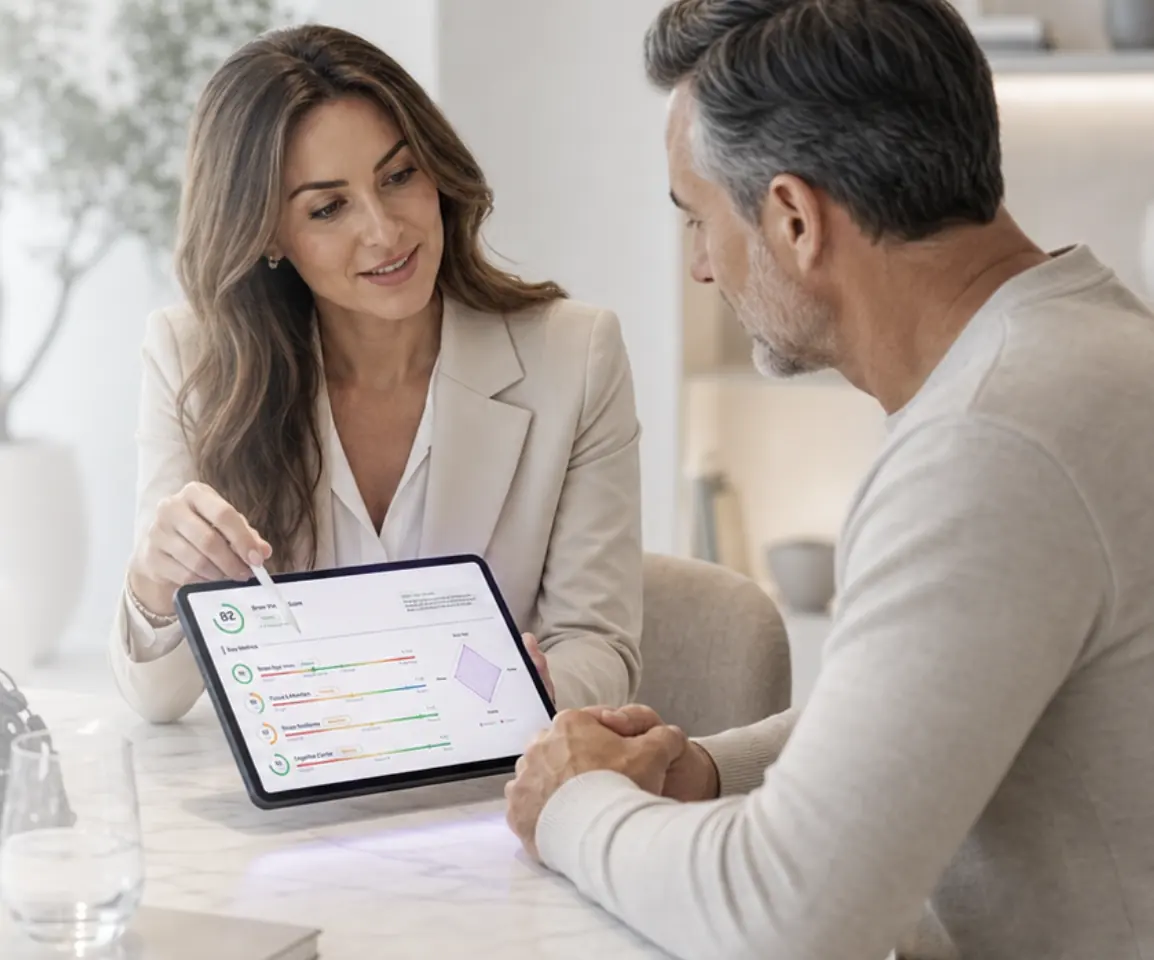
Go through the scores, link them to the client’s goals, and suggest next steps from your own menu. The report carries your center’s name and logo.
07
Offer a brain training program
Sessions are games the client plays with their brain activity instead of their hands, a method called neurofeedback. A typical program is about 25 minutes per session, 15 to 20 sessions, one to three a week.
08
Reassess regularly
Depending on where the client stands, reassess a few times a month or once a quarter, so the client can compare scores with the first one, and adjust the protocol if needed. Scores vary from day to day, so treat one reading as a snapshot, not a verdict.
A typical client journey: assessment during the first visit, training at two sessions a week for about eight to ten weeks, reassessments along the way, then a new cycle or a maintenance plan.
See these steps with your own team: we bring the kit for a demo day.
From the second visit, trend charts show each score over time. The recording uses 21 EEG channels, and scores are compared with a reference group of the same age and sex.
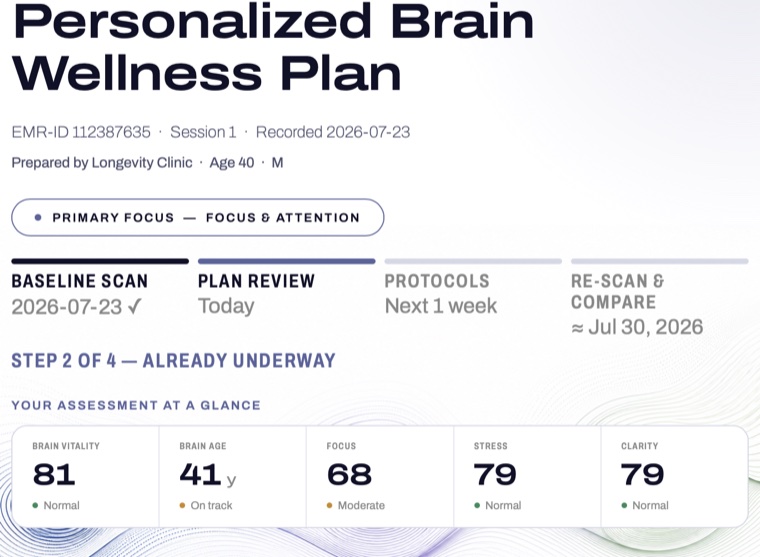
Personalized Brain Wellness Plan
1
At home: Self-guided routines such as breathwork, aerobic activity, meditation, sleep habits and yoga, with weekly targets and a tracker.
2
In-center wellness: Services from your own menu, such as HRV biofeedback, brain training, cryotherapy or hammam.
3
Clinician-led options: Listed only for the client to raise at their review. A clinician decides whether any is appropriate.
Each recommendation links to general published research on that activity, and the plan ends with the date of the next assessment, so the client leaves with a reason to come back.
How centers offer it
Free or in a membership. Programs are paid.
Most centers offer the assessment free or build it into a membership, and charge for the brain training programs that follow. The assessment works as your consultation: a client with numbers in front of them has something concrete to discuss, and without numbers a recommendation sounds like “try this, try that”.
The reassessment gives clients a reason to return. A program with a clear end point and a second report is easier to renew.
The report connects to the rest of your menu. Each assessment is a natural moment to talk through recovery, sleep, movement and coaching services you already offer. Medical services stay a clinician’s decision.
Before you sign
Ten questions to ask a provider
They separate a service you can run every day from a device that sits in a cupboard.
Question
Why it matters
Does it record brain activity (EEG), or rely on questionnaires and computer tests?
Questionnaires capture how a client feels; a recording adds a direct measure.
Dry sensors or gel?
Gel means hair washing and longer setup; dry caps fit a busy schedule.
How long does one assessment take?
Ten minutes fits a routine visit; forty minutes needs its own appointment.
Can you repeat it so clients can compare scores?
The reassessment gives clients a reason to return.
Does it connect results to training and to your other services?
A report with no next step is a one-off test.
Does the report carry your brand, in your clients’ languages?
Clients should remember your center, not the vendor.
How long does staff training take? Do you need a neuroscientist?
You want front-line staff to run it after a short training.
Where is client data stored, and who can access it?
Brain data is personal data; ask for the server location in writing.
What is included in the price?
Check updates, replacement caps, onboarding, and support hours in your time zone.
What research does the provider cite?
A serious provider links to peer-reviewed studies and is clear about what they show.
Keep it a wellness service
Position the assessment as wellness from day one: it does not diagnose, treat, cure or prevent any disease or condition.
Call it a brain wellness assessment, not a medical test or a scan.
Staff explain scores and next steps; they do not interpret results medically. Clients with a health concern should speak to their doctor.
Talk about tracking and comparing scores, not about curing or fixing anything.
FAQ
Questions centers ask about setup
How much space do I need?
A quiet room of about 6 m² with a comfortable chair. One kit serves one client at a time.
Who on my team should run it?
Usually a nurse or a longevity expert. Each person learns it in under an hour, and we train your whole team on site in one day.
How many kits should I start with?
Two, if you plan to run assessments and training sessions on the same days. One is enough to start with assessments only.
How fast can we start?
As fast as one week from a signed and paid contract.
How long does the assessment take?
About 10 minutes, including 6 minutes of recording. The client sits and relaxes.
What is in the kit?
Two dry caps (medium and large), an amplifier, a tablet and a carrying case.
How do I set up brain monitoring for my longevity center?
In a longevity center, brain monitoring usually means a 10-minute non-invasive brain assessment at intake, regular reassessments, and a brain training program for clients who want to work on their scores. The 8 steps above cover the setup.
How often should clients be reassessed?
It depends on where the client stands: centers reassess anywhere from a few times a month to once a quarter.
Is it a medical test?
No. It is a non-invasive wellness assessment. It is not a diagnosis and is not designed to detect any medical condition.
Demo day
See it in your own center
We bring the kit for a day, train your team and assess your clients for free.
Your team runs real assessments with us in the room